Viet Water provides engineering, design, and construction services for ESG-compliant wastewater trea...
Three Levels of DEERFOS MBR Membrane Cleaning
Three Levels of DEERFOS MBR Membrane Cleaning – A Comprehensive Guide to Maintaining Performance and Extending Membrane Life
MBR (Membrane Bioreactor) membrane systems have become increasingly popular in industrial wastewater treatment, municipal wastewater treatment, hospitals, food and beverage processing, pharmaceutical manufacturing, and electronics industries due to their superior treatment performance and excellent effluent quality. However, to ensure stable system operation and maintain the designed filtration capacity, regular MBR membrane cleaning is essential.
During operation, organic matter, microorganisms, inorganic scale, and colloidal particles gradually accumulate on the membrane surface, causing an increase in Transmembrane Pressure (TMP) and a reduction in permeate flux. If membrane fouling is not addressed promptly, the system will consume more energy, experience reduced treatment efficiency, and suffer from a shortened membrane service life.
According to the technical guidelines issued by DEERFOS, membrane maintenance is divided into three cleaning levels, each corresponding to a different degree of membrane fouling. Performing the appropriate cleaning procedure at the right time helps extend membrane life, maintain optimal treatment performance, and significantly reduce operating costs.
Why Is Regular MBR Membrane Cleaning Important?
MBR membranes are among the most valuable components of any wastewater treatment system. During continuous operation, the membrane surface is exposed to various foulants that gradually reduce filtration performance.
The primary causes of membrane fouling include:
- Dissolved organic matter
- Microorganisms and biofilm
- Inorganic scale such as calcium carbonate (CaCO₃), iron (Fe), and manganese (Mn)
- Oil and grease
- Suspended solids (SS)
- Polymers and colloidal substances
If membranes are not cleaned at the appropriate intervals, the following operational problems may occur:
- Continuous increase in Transmembrane Pressure (TMP)
- Reduction in permeate flux
- Increased energy consumption
- Shorter filtration cycles
- Reduced treatment efficiency
For this reason, DEERFOS recommends implementing a three-level membrane cleaning program based on the severity of membrane fouling.
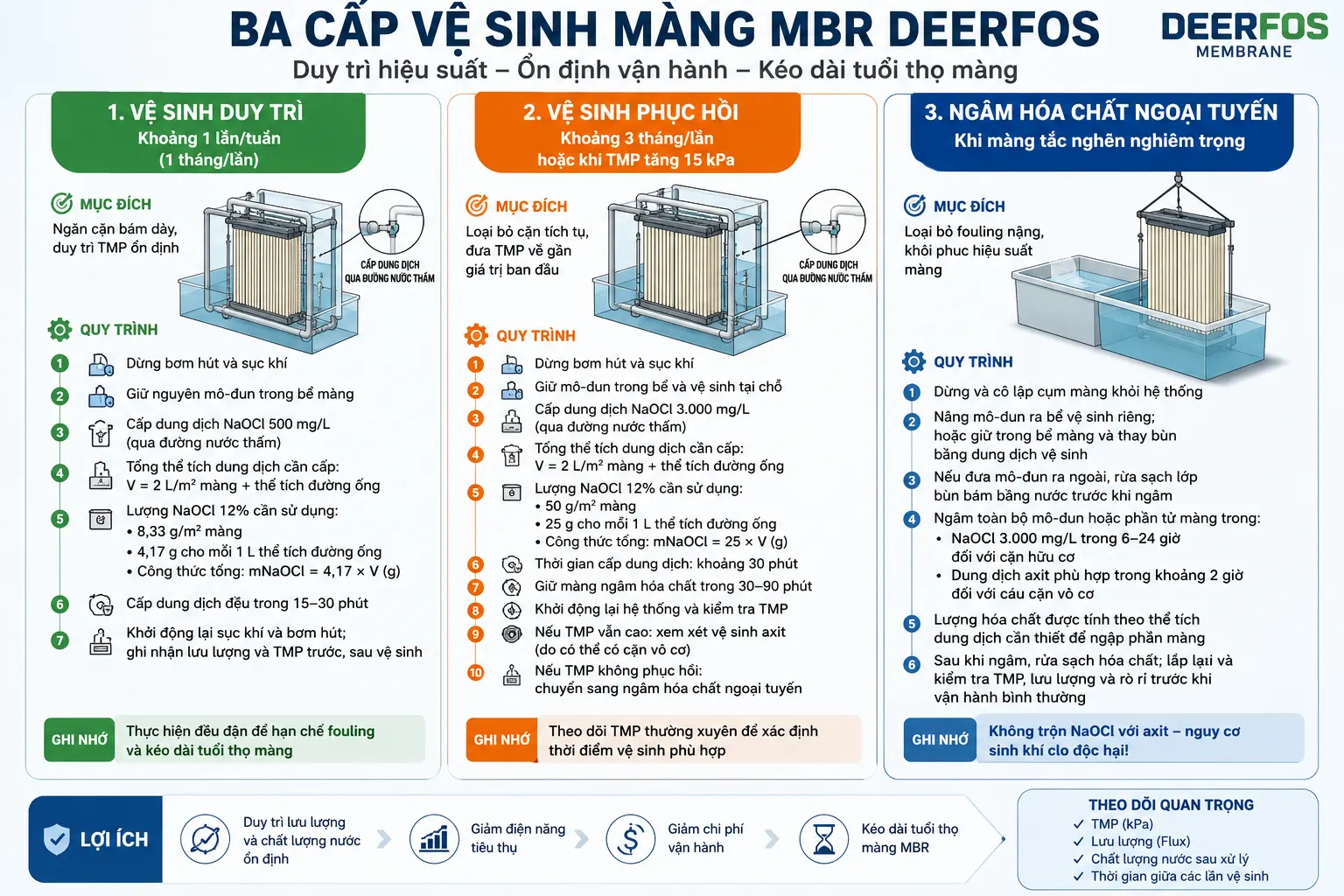
Level 1 – Maintenance Cleaning
Maintenance Cleaning is performed regularly to prevent early-stage membrane fouling. This routine cleaning helps maintain membrane performance while minimizing the need for intensive chemical cleaning.
Under normal operating conditions, Maintenance Cleaning is recommended approximately once per week. Depending on influent quality and fouling rate, some systems with stable operating conditions may extend the cleaning interval to approximately once per month.
Purpose
Maintenance Cleaning aims to:
- Prevent the accumulation of organic foulants
- Maintain stable Transmembrane Pressure (TMP)
- Sustain the designed permeate flux
- Reduce the risk of severe membrane fouling
- Extend membrane service life
Maintenance Cleaning Procedure
Step 1. Stop System Operation
- Stop the permeate suction pump.
- Shut down the aeration system according to the operating procedure.
Step 2. Keep the Membrane Module in Place
The membrane module does not need to be removed from the membrane tank.
All cleaning operations are performed in situ inside the membrane tank.
Step 3. Prepare the Sodium Hypochlorite Solution
Prepare a cleaning solution with a concentration of:
NaOCl 500 mg/L
The solution should be introduced through the permeate line.
Important: Never pour sodium hypochlorite directly into the biological reactor or sludge tank, as it may damage the activated sludge microorganisms.
Step 4. Calculate the Required Cleaning Solution Volume
The total cleaning solution volume is calculated as:
V = 2 liters × membrane area (m²) + pipeline volume
where:
- V = Total cleaning solution volume (L)
Step 5. Calculate the Required Amount of 12% Sodium Hypochlorite
For commercial 12% NaOCl solution, use:
Membrane section
- 8.33 g NaOCl per m² of membrane area
Pipeline section
- 4.17 g NaOCl per liter of pipeline volume
A simplified calculation is:
mNaOCl = 4.17 × V (g)
where:
- mNaOCl = Required sodium hypochlorite dosage (g)
- V = Total cleaning solution volume (L)
Step 6. Chemical Injection
Inject the cleaning solution uniformly over approximately:
15–30 minutes
After completing chemical injection:
Restart:
- Aeration system
- Permeate suction pump
Record the following operating parameters:
- TMP before cleaning
- TMP after cleaning
- Permeate flow rate
These data provide valuable information for evaluating cleaning effectiveness and planning future maintenance schedules.