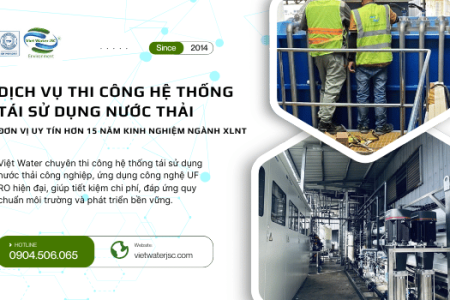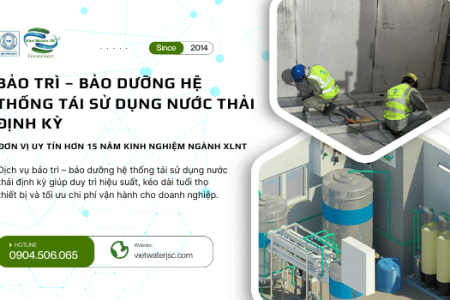
Upgrading wastewater reuse systems
10 Jan, 2026Upgrading wastewater reuse systems is not only a technical improvement but a long-term economic and...
Ensuring Stable Performance, Water Quality, and Long-Term Cost Efficiency
After design and construction, the operation of a wastewater reuse system is the most critical phase determining the overall success of the investment. Even a well-designed system can quickly lose efficiency, suffer water quality instability, and incur high operating costs if it is not operated properly.
This article presents a practical guide to operating wastewater reuse systems, based on real operational experience from Việt Water JSC, focusing on stability, safety, and long-term cost optimization.

Operating a wastewater reuse system includes:
Continuous monitoring and control of treatment units
Adjustment of operating parameters based on actual loading conditions
Maintaining consistent water quality that meets reuse standards
Ensuring safe, stable, and uninterrupted system operation
The ultimate goal is not simply to “run the system,” but to maintain high performance at the lowest possible operating cost throughout the system’s lifecycle.
Pre-treatment protects downstream membrane systems, especially UF and RO. Key operational points include:
Monitoring pressure drop across filters
Performing backwash cycles at the correct frequency
Controlling turbidity and suspended solids in influent water
Ensuring stable operation of self-cleaning filters, sand filters, and carbon filters
Poor pre-treatment performance is one of the leading causes of membrane fouling and scaling.
The UF system removes fine solids, bacteria, and colloids, providing stable feed water for RO. Operators should:
Monitor UF transmembrane pressure
Follow proper backwash and chemical cleaning (CIP) schedules
Avoid operating beyond design flow rates
Regularly check water quality after UF (turbidity, SDI)
Proper UF operation significantly reduces RO maintenance costs.
RO is the most critical process in wastewater reuse systems. Key operational requirements include:
Monitoring pressure, flow rate, and recovery ratio
Tracking permeate TDS and conductivity
Controlling antiscalant and chemical dosing
Performing CIP promptly when performance declines
Correct RO operation extends membrane life and ensures consistent reuse water quality.
Depending on system design, disinfection may use UV, chlorination, or a combination of both:
Maintain adequate UV intensity or residual chlorine levels
Ensure sufficient contact time
Conduct periodic microbiological monitoring
Keep reuse water distribution clearly separated from potable water systems
Effective operation requires continuous monitoring of:
Flow rates and pressures at each treatment stage
pH and water temperature
Turbidity, TDS, and conductivity
Differential pressure across UF and RO membranes
Final water quality based on reuse objectives
Early detection of abnormal trends helps prevent major system failures.
Operation and maintenance must go hand in hand:
Regular cleaning of filters and storage tanks
Scheduled CIP for UF and RO membranes based on performance indicators
Inspection of pumps, valves, sensors, and electrical systems
Timely replacement of consumables
Preventive maintenance reduces unexpected downtime and long-term operating costs.
Based on field experience, common mistakes include:
Poor control of influent water quality
Neglecting pre-treatment performance
Incorrect chemical dosing
Operating above design capacity
Delaying CIP procedures
Insufficient operator training
These issues can significantly increase OPEX and shorten system lifespan.
Modern wastewater reuse systems typically integrate:
PLC/SCADA-based automatic control
24/7 monitoring of critical parameters
Early warning alarms for abnormal conditions
Data logging for compliance, auditing, and ESG reporting
Automation improves operational reliability and reduces dependence on manual intervention.
Việt Water JSC provides comprehensive operational support services, including:
Operator training and capacity building
Development of standard operating procedures (SOPs)
Scheduled maintenance and membrane CIP services
System optimization to reduce operating costs
Rapid technical support when operational issues arise
Enterprises can explore detailed solutions at:
WASTEWATER REUSE SYSTEM
The operation of a wastewater reuse system is the decisive factor in achieving stable water quality, economic efficiency, and long-term sustainability. With proper operation, preventive maintenance, and automation, wastewater reuse systems can deliver significant cost savings while supporting ESG and circular economy goals.
With strong technical expertise and practical field experience, Việt Water JSC is ready to accompany enterprises throughout the entire operation and optimization journey of wastewater reuse systems.
Upgrading wastewater reuse systems is not only a technical improvement but a long-term economic and...
Maintenance and servicing of wastewater reuse systems are not optional—they are essential for ensuri...
This article outlines the construction process and critical considerations for wastewater reuse syst...